Hallo,
ich sage mal "ja!" ... aber möchtest du es genauer wissen (habe gerade gesucht

).
Also mir war bekannt, dass
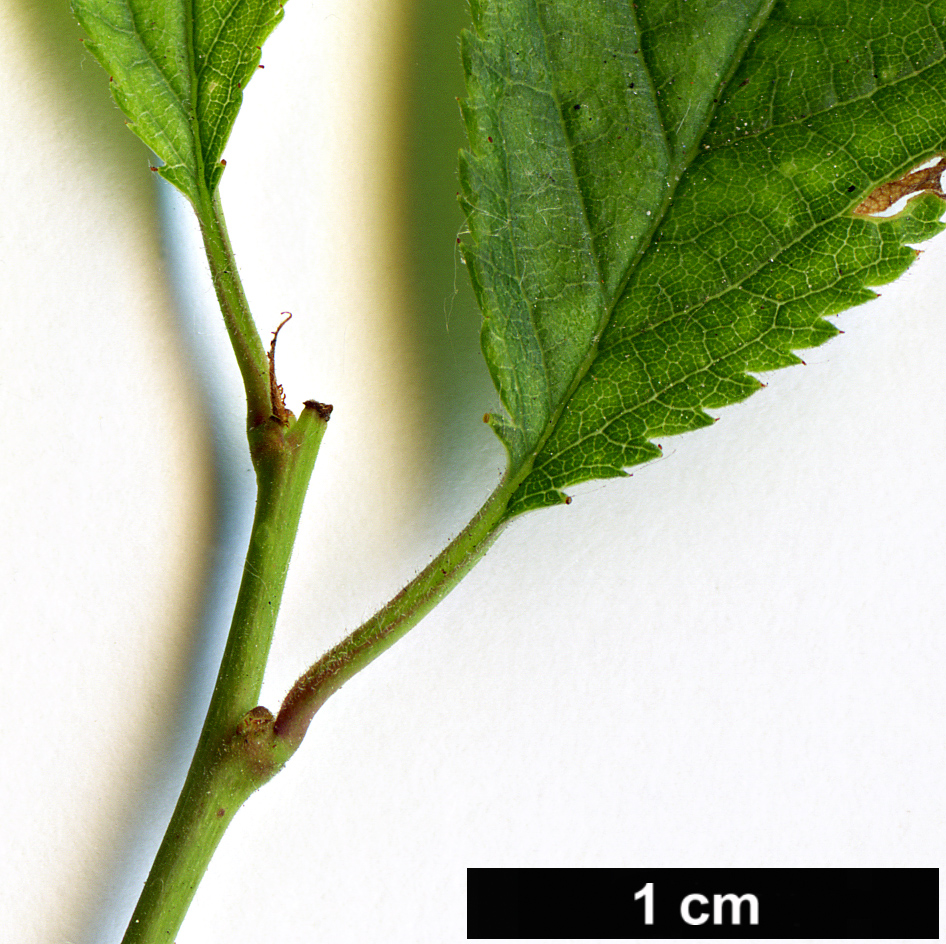
Prunus spinosa nicht diese (über)-deutlichen Drüsen am Blattstiel hat. Aber oft ist es so - auch bei anderen Pflanzen -, dass die Drüsen zum Teil auch an den Spitzen der Zähne, besonders im untersten Blattteil zu finden sind.
Bilder von Jan (JDL) beim Arboretum Wespelaar zeigen das, was deinem Fund entspricht, bei
Prunus spinosa auch - manchmal ganz deutlich, manchmal weniger deutlich.
Hier so eine bräunliche Verdickung an den untersten Zähnen:
https://www.arboretumwespelaar.be/UserF ... 018_02.jpg
Nun habe ich mal "Prunus spinosa glands" gesucht und eine wissenschaftliche Arbeit zu den Drüsen bei Rosaceen gefunden (leider nur Abstract öffentlich zugänglich)
"The Bitter and the Sweet: Inference of Homology and Evolution of Leaf Glands in Prunus (Rosaceae) through Anatomy, Micromorphology, and Ancestral–Character State Reconstruction" Siew-wai Chin, Sue Lutz, Jun Wen and Dan Potter aus: International Journal of Plant Sciences
Volume 174, Number 1January 2013
https://www.journals.uchicago.edu/doi/10.1086/668219
Abstract
Distinctive and diagnostic leaf glands occur in diverse forms and positions in Prunus. However, barely any studies have been conducted to document and examine these forms. Leaf glands in Prunus species may occur as raised structures on the leaf margin, as flattened structures on the abaxial surface, or at the tips of leaf teeth. Dark punctate spots on the abaxial surface of some tropical species have been assumed to be glandular as well. Our results show that the raised glands on the leaf margin and the flat glands on the abaxial surface share similar anatomy with extrafloral nectaries, while glands on the leaf teeth are structurally similar to colleters. Leaf glands in Prunus can be divided into class 1A (raised, marginal) and class 1B (flat, laminar) extrafloral nectaries and class 2 (leaf-teeth colleters). The derived flat glands likely evolved as a result of an adaptive loss of leaf serrations in warmer climates, while the plesiomorphic glandular-teeth condition is indirectly selected for in cooler climates because of an adaptive advantage of serrated margins. The dark punctate spots are shown for the first time to be d-stomatal-type cork warts that do not perform a glandular function.
Den Begriff "Colleter" kannte ich nicht, finde ich auch nicht in deutschsprachigen biologischen Glossaren (online), in engl. franz. etc. schon.
https://en.wikipedia.org/wiki/Glossary_ ... ical_terms
Colleter: A multicellular, glandular hair that usually produces a mucilaginous substance and is located on sepals, stipules, or petioles, or on nearby parts of stems; commonly found on plants in the order Gentianales.
Vielleicht sagt man im Deutschen einfach nur "Drüsenhaar" (aber "haarig" ist das hier eigentlich ja nicht). "So etwas" scheint jedenfalls morphologisch einen bestimmten Aufbau zu haben, ansonsten würde man das nicht noch unterscheiden.
"plesiomorphic" musste ich auch nachschauen
 https://de.wikipedia.org/wiki/Plesiomorphie
Als Plesiomorphie (von altgriechisch πλησίος plēsíos „benachbart“, und μορφή morphḗ „Form, Gestalt“) bezeichnet man in der entwicklungsbiologischen Systematik und Kladistik eine ursprüngliche Merkmalsausprägung, die vor der betrachteten Stammlinie entstanden ist und in dieser unverändert erhalten blieb. ...
Dann noch dies zu den "Colleters" (also den Drüsen auf den Blattzähnen) bei
Rhaphiolepis loquata (Vermutlich kann man das für andere Arten der Rosaceen auch so annehmen, obwohl noch nicht untersucht.)
Anatomical and histochemical characterization of glands associated with the leaf teeth in Rhaphiolepis loquata B.B.Liu & J.Wen (Rosaceae Juss.)
Maycon de Sousa Silva a, Ítalo Antônio Cotta Coutinho b, Valdnéa Casagrande Dalvi aus: Flora Volume 293, August 2022, 152110
https://www.sciencedirect.com/science/a ... 3022001074
Abstract
Several representatives of Rosaceae are characterized by presenting leaf teeth. These projections on the leaf margins may be associated with different secretory structures such as extrafloral nectaries, hydathodes or colleters. Colleters are the secretory structures far less known in Rosaceae. Although colleters were previously mentioned in species from subfamily Amygdaloideae, authors fail to provide a detailed morphoanatomical description and the chemical nature of the secretion for those colleters. Therefore, we aimed to morphoanatomically describe the leaf teeth of Rhaphiolepis loquata, confirming the nature of the gland associated with the teeth and shedding light on the chemical composition of the gland exudates. For that, samples from the leaf margins at different stages of development were collected and fixed according to standard techniques for both light and scanning electron microscopy. The leaf teeth in R. loquata presented a colleter at its apex. Colleters were rounded with covered by single- or doubled-layered secretory palisade covered with thick cuticle and the central axis was made up of parenchyma cells. The presence of polysaccharides, pectins and proteins was confirmed in the exudates and phenolic compounds accumulated as the gland aged and ceased the exudate production. An abscission zone at the base of the colleter was observed what could cause the falling off of older, non-secreting colleters. This is the first study on the chemical composition of colleter exudates as interpreted through histochemical tests, being a novelty not only for R. loquata but for the Rosaceae family.
Also man hat diese "Anhängsel" an den Zähnchen morphologisch untersucht, wie sie aufgebaut sind, was sie ausscheiden und auch festgestellt, dass die Strukturen altern und eine "Sollbruchstelle" haben und abfallen.
 .